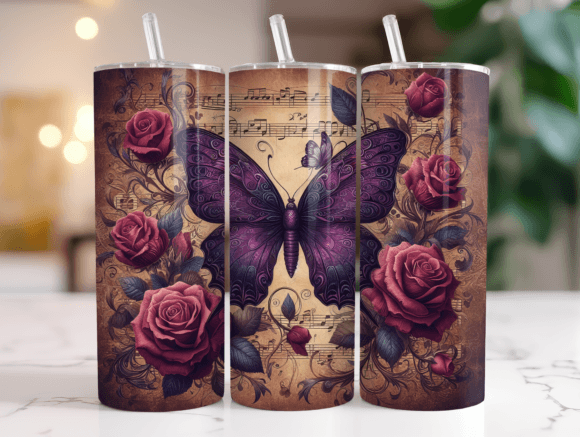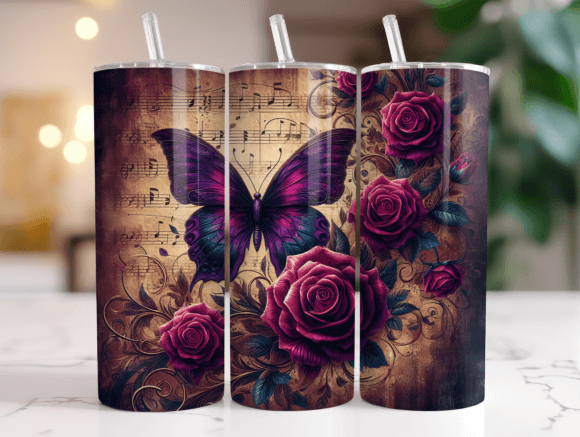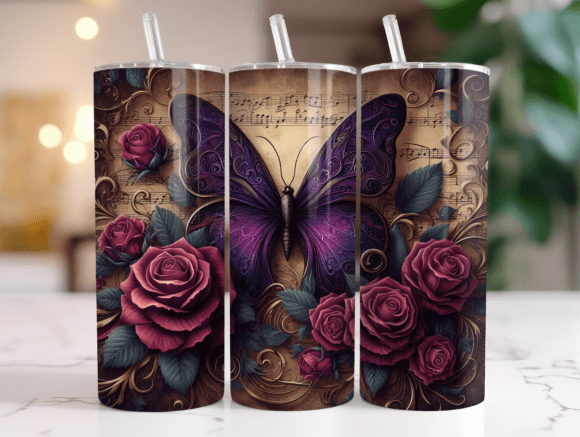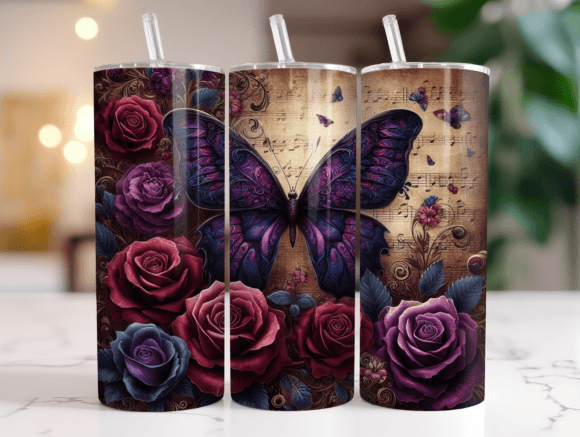
Purple Vintage Butterfly Tumbler Wrap
First Impression: Delicate, Nostalgic, and Surprisingly Versatile
When I opened Purple Vintage Butterfly Tumbler Wrap, I wasn’t expecting much beyond a trendy placeholder—but what landed in my preview window was quietly charming. The design balances soft purple tones with muted gold and charcoal accents, evoking pressed botanicals and old apothecary labels. It’s not overly busy, yet it carries enough detail to feel intentional: wing veining rendered with subtle line weight variation, gentle curving stems, and a slight asymmetry that reads as hand-drawn rather than algorithmically perfect. As a designer who’s stitched hundreds of butterfly motifs—from hyper-realistic monarchs to minimalist silhouettes—I immediately sensed this one would translate well to embroidery: it avoids micro-detail traps (no 0.5mm antennae or pixel-thin filigree), and its natural flow suits organic fabric surfaces like cotton twill, linen blend tea towels, or brushed poly sweatshirts.
A Real-World Test: Stitching It onto a Linen-Cotton Apron for a Local Bakery
Last week, I used Purple Vintage Butterfly Tumbler Wrap as the centerpiece on a custom apron for a neighborhood sourdough bakery. Their branding leans into heritage warmth—think burlap sacks, handwritten chalkboards, and dried lavender bundles—so the vintage butterfly felt like a quiet extension of their voice, not a decorative afterthought. I resized it slightly (keeping proportions intact) to fit a 4” x 5” hoop, stabilized with medium-weight cutaway, and ran it on midweight linen-cotton blend. The result? Crisp satin-stitched wings held shape without puckering; the fill-stitch body had just enough texture to read as dimensional, not flat. Customers noticed it—not as “a butterfly,” but as *the* apron detail that made the whole piece feel considered. That’s the quiet power of this design: it elevates handmade product without shouting.
Where It Shines—and Where It Needs Thoughtful Handling
Purple Vintage Butterfly Tumbler Wrap works beautifully on stable, medium-to-heavy fabrics: tote bag fronts, pillow covers, baby onesies (with appropriate stabilizer), and even structured cap fronts—if you adjust placement to avoid excessive curve distortion. Its open negative space breathes well on textured surfaces like terry cloth towels or loopback fleece, and the moderate stitch density keeps wash durability high. For Etsy sellers listing personalized gifts, it adds instant charm to holiday embroidery kits or nursery decor bundles.
But here’s where attention matters: on stretchy knits (like lightweight jersey tees), the wing edges can blur without proper tear-away + cutaway combo stabilizing. On dark fabric, test thread contrast first—the purple tones soften visually when stitched in navy or charcoal thread; switching to heathered lilac or antique rose improves legibility. And while it’s lovely on curved mugs or tumblers *as a wrap graphic*, remember: this is a digital embroidery file, not a heat-transfer vinyl cut. Don’t assume it’s optimized for tight-radius stitching unless verified. For caps or curved seams, always do a test run on scrap fabric pinned to a cap hoop.
Design Integrity in Commercial & Handmade Contexts
What sets Purple Vintage Butterfly Tumbler Wrap apart from generic clipart isn’t just aesthetics—it’s how it supports your brand story. When stitched on a boutique tea towel, it doesn’t scream “digital download”; it reads as part of a cohesive collection. That builds customer trust. Buyers browsing your Etsy shop don’t see “AI-generated”—they see intention, care, and consistency. Used across multiple small shop products (a matching patch set, embroidered napkins, and a limited-run sweatshirt), it becomes recognizable visual shorthand for your shop’s gentle, vintage-leaning aesthetic.
That said, don’t skip due diligence. Before listing finished items or reselling the design as part of a craft kit: confirm licensing terms. This listing states it’s an AI-generated, Photoshop-enhanced digital file—so verify whether commercial use, derivative creation, or resale of stitched items is permitted. Also, check if the file includes alternate versions (black-and-white outline, simplified line art) for printable mockups or screen-print prep. Those extras dramatically expand your design assets without extra design time.
Practical Notes Every Embroidery Designer Should Run Through
- Test first—always stitch Purple Vintage Butterfly Tumbler Wrap on scrap fabric matching your final project’s weight and stretch.
- Review stitch density—dense fill areas (like the body) may need reduced density on delicate fabrics like rayon or silk-blend baby blankets.
- Confirm hoop size compatibility—if your machine’s max hoop is 4x4”, check whether the design fits or requires resizing (and whether scaling affects wing proportion).
- Inspect small details—the antenna tips and stem ends are fine but not fragile; still, avoid ultra-fine threads (like 100wt) unless testing confirms clarity.
- Try black-and-white mockups—this design relies on tonal nuance, so seeing it in grayscale helps anticipate contrast on light/dark garments.
- Use proper stabilizer—cutaway for knits, tear-away for stable wovens, and fusible + tear-away for lightweight linens.
- Check dual-use readiness—if you plan to offer both physical embroidered goods and digital embroidery files, ensure the license allows both.
Final Thought: A Thoughtful Tool, Not Just a Trend
Purple Vintage Butterfly Tumbler Wrap won’t replace your go-to floral monogram or signature script—but it fills a specific, valuable gap: a ready-to-stitch motif that feels curated, not canned. It’s the kind of design that makes a baby gift feel heirloom-adjacent, turns a plain tote into a conversation starter at a craft fair, and gives your small shop merchandise quiet confidence. Used intentionally—with attention to fabric, stabilizer, and context—it does more than decorate. It connects. And in today’s handmade market, that connection is the most valuable stitch of all.